MESSAGE ON ECOLOGICAL DEGRADATION AND CONSERVATION OF LOKTAK LAKE
(Theme: Wetlands and Human Wellbeing)
Dr. Rajkumar Ranjan Singh
Loktak Lake, the largest freshwater lake in Northeast India and a Ramsar site of international importance, stands as a critical fluvial-lacustrine ecosystem whose health in intrinsically linked to the wellbeing of thousands who depend upon it. On this World Wetlands Day, we draw attention to the urgent ecological challenges facing this unique wetland and the dedicated efforts underway to restore its vital functions.
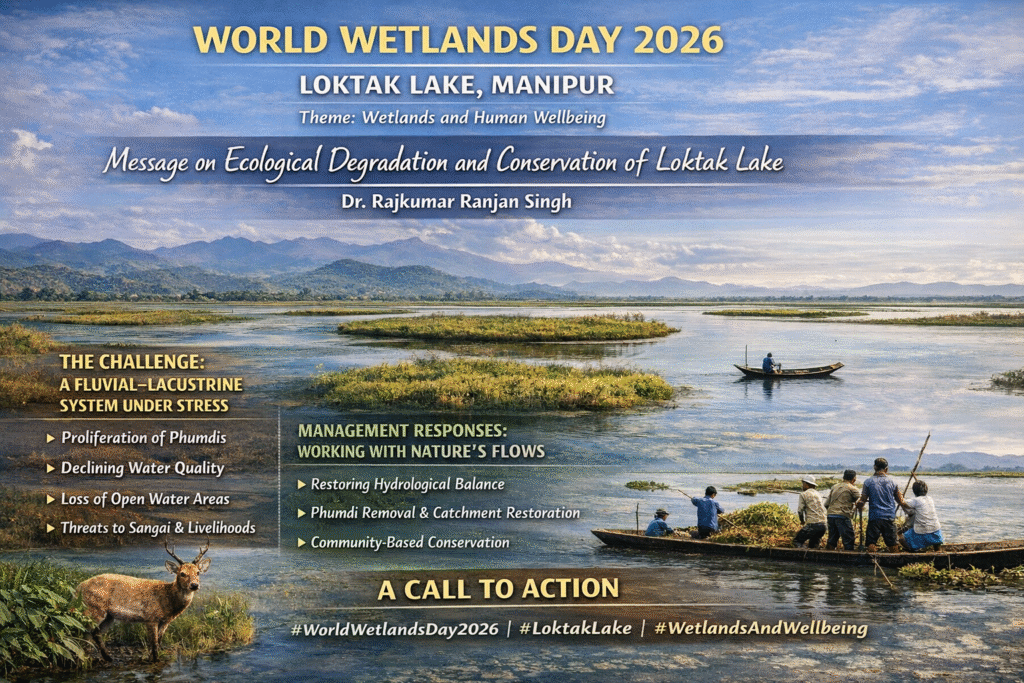
THE CHALLENGE: A FLUVIAL-LUCUSTRINE SYSTEM UNDER STRESS
Loktak Lake’s distinctive character as a fluvial-lacustrine system where riverine and lake processes interact has been fundamentally altered over recent decades. The construction of the Ithai Barrage in 1983, intended for hydroelectric power generation, disrupted the lake’s natural hydrological rhythm.
The loss of seasonal water fluctuations has triggered a cascade of ecological degradation: the proliferation of phumdis (floating vegetation/bio-mass mats) now covers excessive portions of the lake surface, sedimentation has accelerated due to reduced flushing capacity, water quality has deteriorated with declining dissolved oxygen levels, and the lake’s open water areas has steadily contracted.
These changes have severely impacted the Keibul Lamjao National Park, the world’s only floating national park and home to the endangered Sangai deer, while also threatening the livelihoods of fishing communities and the lake’s role as a natural flood regulator of the Valley of Manipur.
MANAGEMENT RESPONSES:
WORKING WITH NATURE’S FLOWS
Recognizing the intrinsic connection between the lake’s fluvial-lacustrine characteristics and its ecological health, management efforts have focused on restoring natural hydrological processes.
The Loktak Development Authority, in collaboration with local communities and conservation organizations, has implemented several strategic interventions: controlled water level management to stimulate seasonal variations, systematic phumdi harvesting in critical zones while preserving ecologically important floating islands, catchment area restoration to reduce sediment loads entering the lake system, community-based monitoring programs that engage local fishers as wetland stewards, and plans that balance conservation with sustainable livelihoods.
These efforts acknowledge that Loktak’s health depends on maintaining the dynamics interplay between riverine inputs and lacustrine processes that has sustained this ecosystem for millennia.
A CALL TO ACTION
As we observe World Wetlands Day 2026, Loktak Lake reminds us that wetland conservation requires understanding and respecting the natural processes that sustain these ecosystems. The path forward demands continued scientific research into the lake’s hydrological dynamics, increased resources for restoration and monitoring, meaningful participation of local communities in decision making, and policy frameworks that prioritize ecological integrity alongside development needs.
Loktak Lake is more than a wetland – it is a living testament to the profound connection between human wellbeing and healthy ecosystems. Its restoration is both an ecological imperative and a commitment to the communities whose lives are woven inti its waters.
Let us renew our dedication to protecting and restoring this irreplaceable wetland for present and future generations.
#WorldWetlandsDay2026 #LoktakLake #WetlandsAndWellbeing
Author Profile

Latest entries
 UncategorizedFebruary 3, 2026अंतरराष्ट्रीय मानव बंधुता दिवस और हमारा पर्यावरण
- UncategorizedFebruary 3, 2026International Day of Human Fraternity and our Environment
- UncategorizedFebruary 3, 2026विश्व आर्द्रभूमि दिवस 2026 एवं मणिपुर की लोकतक झील
- UncategorizedFebruary 2, 2026WORLD WETLANDS DAY 2026 AND THE LOKTAK LAKE OF MANIPUR